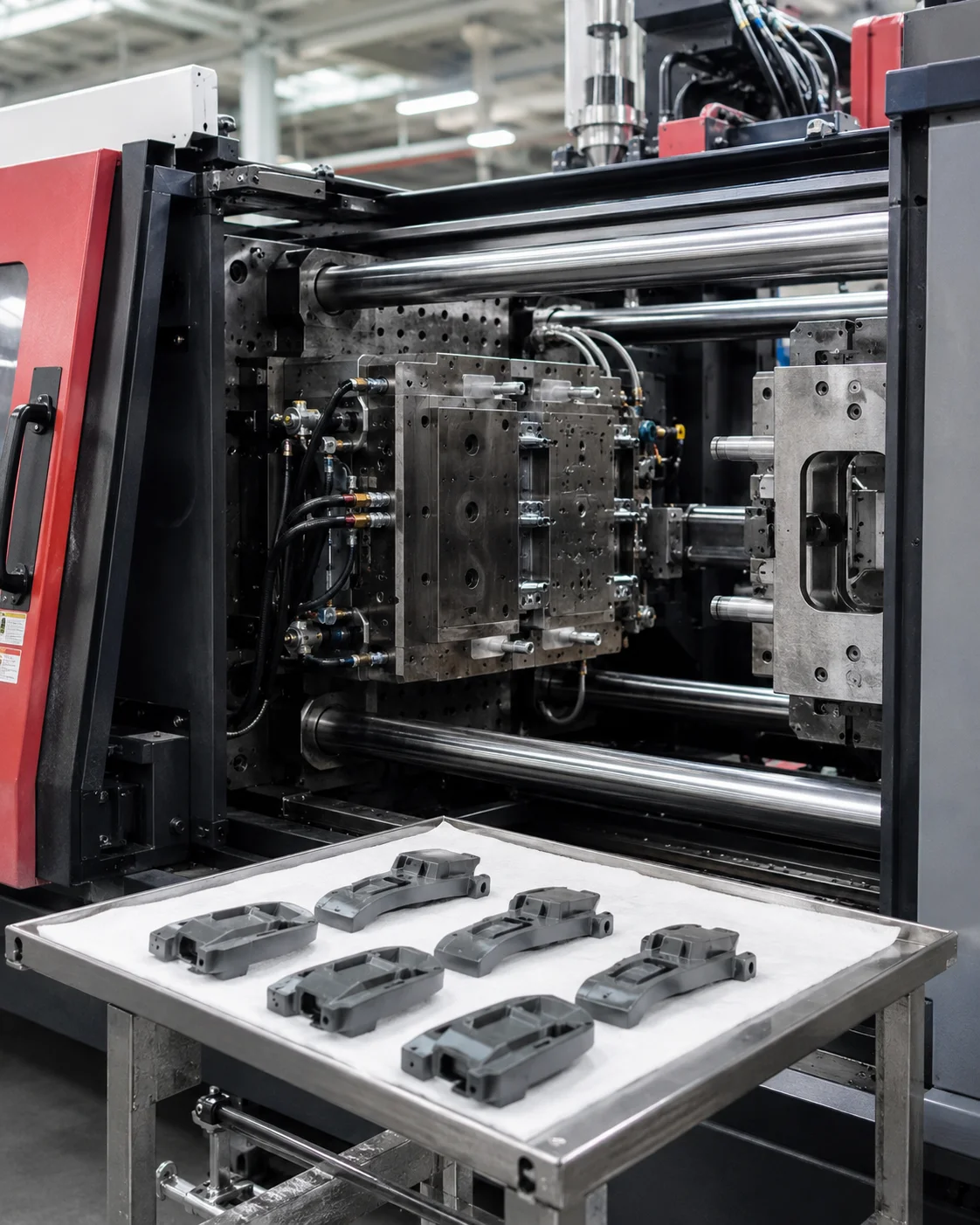
In injection molding, mold cooling is often the hidden factor behind cycle time, dimensional stability, and production efficiency. This becomes particularly important when the purpose of the tool is rapid product validation or low volume production, where every development cycle needs to deliver usable parts without unnecessary waiting.
Aluminum rapid tooling offers an effective approach because aluminum combines high thermal conductivity with relatively easy machining. When the mold structure and cooling system are designed properly, heat can move away from the cavity efficiently, helping molded parts reach ejection temperature faster and supporting more consistent molding conditions.
For manufacturers evaluating rapid tooling, however, the benefit of aluminum is not simply its material properties. Tool design, cooling-channel layout, part geometry, resin selection, and production requirements all determine whether aluminum tooling can deliver the expected performance.
Why Aluminum Matters for Mold Cooling
During injection molding, molten plastic transfers heat into the mold cavity and core. That heat must then move through the tooling material and into the cooling system before the part can be safely ejected.
Aluminum has significantly higher thermal conductivity than many conventional mold steels. This allows heat to transfer through the mold more readily, which can help cooling systems remove heat from the cavity efficiently.
The advantage becomes particularly relevant for rapid tooling because the objective is often to obtain functional molded parts quickly rather than manufacture a mold designed for extremely long production life.
HordRT uses aluminum 7075 as one of its rapid tooling materials. The company describes aluminum 7075 as a common material for rapid prototype tooling because it can be processed quickly, with tooling life depending on the application and conditions.
Cooling Efficiency Has a Direct Effect on Cycle Time
The cooling stage can represent a substantial portion of an injection molding cycle. HordRT notes that cooling commonly accounts for approximately 70% to 80% of the complete cycle in injection molding.
This means that improving cooling performance can have a meaningful effect on overall production time.
A simplified molding cycle includes filling, packing, cooling, mold opening, ejection, and mold closing. Filling and packing may take only a relatively short period, while the molded part often needs to remain sufficiently cool and rigid before ejection.
If heat remains concentrated around thick sections, ribs, bosses, or other difficult geometries, the molding cycle may need to be extended. Removing the part too early can increase the risk of deformation, sink marks, dimensional variation, or other defects.
Aluminum rapid tooling can help dissipate heat efficiently, but the material alone does not determine cooling performance. The cooling channels still need to be positioned according to the actual geometry and thermal requirements of the part.
Cooling Design Starts With Part Geometry
A good aluminum mold does not simply contain cooling channels wherever space is available. The layout should consider wall thickness, core geometry, hot spots, gates, ribs, bosses, and areas with greater thermal mass.
For simple geometries, conventional straight cooling channels may be sufficient. More complicated parts may require baffles, bubblers, inserts, or other cooling features to reach areas that are difficult to cool directly.
HordRT includes cooling among the key elements reviewed during mold design. Its rapid tooling workflow moves from CAD and DFM review into mold design, where cooling, ejection, and runner engineering are considered before machining begins.
This engineering step is important because the best cooling solution must balance heat transfer with manufacturability. Excessively complicated cooling structures can increase tooling cost and machining time without providing meaningful benefits for a short production run.
Aluminum Makes Rapid Tool Manufacturing More Practical
Cooling is only one reason aluminum is attractive for rapid tooling. Its machinability can also shorten the time required to manufacture cavity and core inserts.
HordRT states that its rapid tooling process machines customer-specific cavity and core inserts in aluminum or pre-hardened steel before fitting them into shared or dedicated mold bases. The company offers typical rapid tooling lead times of approximately 5 to 10 working days after design and DFM approval, depending on project complexity and requirements.
Aluminum tooling can therefore support two important objectives at the same time: efficient mold manufacturing and effective heat transfer during molding.
This combination is particularly useful when a project requires functional prototypes, design validation, bridge production, or flexible low-volume manufacturing rather than a mold intended for extended high-volume service.
Match Aluminum Tooling With the Right Resin
Cooling performance also depends on the material being molded. Different thermoplastics have different processing temperatures, shrinkage behavior, viscosity, and cooling requirements.
For example, engineering plastics may require different mold temperatures and processing conditions from commonly used materials such as ABS or PP. Glass-filled materials can also introduce additional considerations related to tool wear and dimensional stability.
HordRT supports production-grade thermoplastics including ABS, PC, PC/ABS, PP, PE, PA, POM, PMMA, PBT, TPE, TPU, and PPS. Tooling material selection is evaluated according to production volume, part geometry, cosmetic requirements, resin, and expected mold life.
This makes material selection a project-level decision rather than a simple choice between aluminum and steel.
Where HordRT Adds Value to Aluminum Rapid Tooling
HordRT combines rapid tooling, injection molding, mold trials, and inspection within one coordinated manufacturing workflow. Its process begins with project review and DFM analysis before moving through mold design, tooling manufacture, fitting, assembly, and T1 validation.
The company also uses shared mold bases for suitable projects, allowing customer-specific inserts to be integrated into standardized tooling structures. HordRT states that this approach can reduce tooling investment and shorten the path to molded parts.
For projects where cooling performance matters, having tooling and molding expertise connected under one workflow can make it easier to identify problems during DFM and mold trials rather than after production begins.
Turn Faster Cooling Into Faster Product Validation
Aluminum rapid tooling is most valuable when its thermal characteristics are considered together with mold design, cooling layout, resin behavior, and the project’s production objectives.
For prototype and low-volume injection molding, efficient heat transfer can help shorten cooling time, while aluminum’s machinability can support faster tool production. HordRT adds DFM analysis, standardized tooling options, in-house mold manufacturing, T1 validation, and dimensional inspection to create a more controlled path from CAD files to functional molded parts.
The result is not simply a faster mold. It is a tooling approach designed to help development teams reach reliable molded parts sooner, evaluate designs under realistic production conditions, and make better-informed decisions before committing to longer-life production tooling.