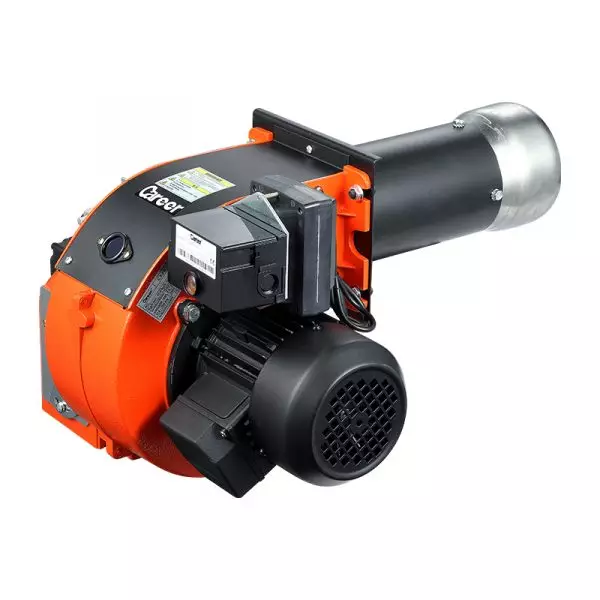
Industrial heating systems often seem to offer a simple choice: use diesel or fuel oil. The decision appears straightforward until operators discover that the two fuels demand entirely different burner designs, operate under different combustion conditions, and deliver different operational characteristics.
The distinction reflects a fundamental difference in fuel properties that cascades through nozzle design, atomization pressure, ignition behavior, and flame stability. Understanding why these differences exist reveals which burner type suits each application.
The Fundamental Fuel Difference: Volatility and Viscosity
Diesel and fuel oil differ in two critical properties: volatility (how readily the fuel evaporates) and viscosity (how thick the fuel is). Diesel is lighter and more volatile with lower energy content per gallon than #2 fuel oil.
It evaporates readily at moderate temperatures, meaning smaller droplets reach combustion temperature and vaporize quickly. This volatility is why diesel ignites faster—the fuel doesn’t need to remain suspended in the combustion zone as long.
Fuel oil is heavier and more viscous, requiring more heat to evaporate. Larger droplets take longer to reach vapor saturation. This slower volatility demands different burner architecture: the combustion chamber must accommodate longer ignition delay, and fuel must be atomized more finely to expose surface area and accelerate evaporation. The energy content of #2 fuel oil is approximately 5 to 7 percent higher per gallon than diesel.
A diesel oil burner is optimized for diesel’s lighter properties; a fuel oil burner is designed around fuel oil’s characteristics. Swapping fuels creates a mismatch: diesel in a fuel oil burner atomizes too finely, cools the flame, and may not ignite reliably; fuel oil in a diesel burner atomizes poorly, creates large droplets, and leaves unburned residue. The difference shows up immediately in flame behavior and efficiency.
Nozzle and Atomization Design Divergence
The fuel nozzle is where the two burner types diverge most visibly. A diesel burner uses a nozzle sized for diesel’s lower viscosity, typically with an orifice diameter of 0.0065 to 0.008 inches. This smaller orifice produces a finer spray at moderate pressure, usually 80 to 100 psi. Fine atomization suits diesel’s volatility: small droplets evaporate quickly, creating a combustible vapor cloud that ignites sharply.
A fuel oil burner uses a larger nozzle orifice, typically 0.009 to 0.012 inches, and operates at higher pressure, usually 100 to 140 psi. The larger orifice accommodates fuel oil’s higher viscosity; at diesel pressure, fuel oil would not flow sufficiently.
Higher pressure and larger orifice together produce a coarser spray that accommodates fuel oil’s slower evaporation, extending the spray into the combustion chamber to give heavier fuel more residence time to vaporize and ignite.
If diesel is forced through a fuel oil nozzle at fuel oil pressure, the spray atomizes too coarsely—creating larger droplets than needed, penetrating too deeply, and cooling the flame.
If fuel oil is forced through a diesel nozzle at diesel pressure, the spray becomes overly fine, evaporates too quickly, cools excessively, and combustion becomes unstable. Pressure differences are architectural necessities, not compensation.
Ignition Speed and Combustion Response
Ignition delay—the time between fuel injection and flame establishment—is shorter for diesel than fuel oil, rooted in volatility. Diesel vapor forms and ignites in approximately 0.3 to 0.5 milliseconds; fuel oil requires 0.8 to 1.2 milliseconds.
A burner designed for fuel oil’s longer ignition delay may ignite diesel almost immediately, creating a sudden pressure spike and a sharp, bright flame that can damage ignition electrodes.
A diesel-optimized burner will struggle with fuel oil’s longer delay, potentially allowing unburned fuel to accumulate before ignition, creating a delayed combustion event with a dull, orange flame.
This difference translates operationally: diesel burners respond quickly to load increases, suitable for applications requiring rapid thermal adjustments. Fuel oil burners respond more slowly, providing smoother combustion that suits heating loads with steady demands.
A diesel burner may handle rapid load changes smoothly, while a fuel oil burner may respond with unstable cycling or hunting; the fuel oil burner’s slower response provides stable baseline operation if load is consistent.
Thermal Stability and Flame Characteristics
The flame produced by each burner type indicates combustion efficiency. A diesel burner on diesel produces a bright, sharp-edged, white-blue flame anchored within 2 to 4 inches of the burner quarl.
The compact flame indicates efficient combustion: most chemical energy converts to heat near the ignition point, and the flame anchors stably under load variations.
A fuel oil burner on fuel oil produces a broader, orange-tinged flame extending 4 to 8 inches from the burner. The extended flame reflects fuel oil’s slower evaporation; combustion stretches across a longer zone as successive droplet layers evaporate and ignite. This shape is normal and appropriate for fuel oil, not inefficient.
If a diesel burner is fed fuel oil, the flame becomes yellowish-orange, elongated, and sooty—indicating incomplete combustion from coarse atomization.
If a fuel oil burner receives diesel, the flame becomes overly bright and sharp, possibly flickering, because fuel ignites faster than the combustion chamber accommodates.
Application Reality: When Each Type Delivers
Diesel burners suit applications requiring responsive thermal control and frequent load adjustments: process heating, modulating boiler systems, and facilities where ambient heating load varies with conditions.
Quick ignition and stable combustion suit environments where thermal setpoint changes regularly. Career Burner‘s diesel burner lineup includes units designed for responsive-demand applications.
Fuel oil burners suit applications with steady, consistent heating loads: large-capacity boilers, district heating, and industrial facilities with stable, continuous thermal demand.
The slower but more stable combustion provides reliable long-term output without load swing sensitivity. Higher energy content per gallon makes fuel oil economical in high-volume applications.
Seasonal and regional constraints also apply. Where diesel supply is consistent, diesel burners dominate. Where fuel oil is the standard distribution fuel, fuel oil burners are more practical—supply chains and storage systems are optimized for #2 oil delivery.
The Operational Choice
The decision between diesel and fuel oil burners should be driven by three factors: the fuel available and cost-effective in the region, the application’s thermal responsiveness requirements, and maintenance capacity. Selecting the wrong type creates efficiency losses and shorter equipment life.
Each burner type is optimized for its fuel; swapping fuels operates equipment outside its design envelope. Industrial heating systems that respect this distinction achieve predictable efficiency, longer equipment life, and stable thermal control.