An ergonomic dental chair should do more than position a patient comfortably. Its geometry, movement, controls, and surrounding equipment influence how easily a clinician can approach the treatment area and maintain a workable posture. That makes ergonomics a practical performance issue rather than simply a comfort feature.
Price complicates the comparison. A basic unit may provide essential positioning functions at a lower acquisition cost, while a more sophisticated system can incorporate additional adjustment, controls, and accessories. The important question is whether those differences produce useful value during everyday treatment.
What Actually Makes a Dental Chair Ergonomic?
Ergonomics begins with positioning. A clinician needs to approach the patient without repeatedly twisting, reaching excessively, or working from an awkward height. The patient chair, headrest, instrument delivery system, and dentist stool therefore need to function as one working environment.
Roson’s N1 provides a useful example of an integrated ergonomic configuration. Its listed design includes a multi-articulated headrest, a rotatable right armrest, multifunction foot control, adjustable instrument placement, and an integral dentist stool backrest. The manufacturer also offers over-the-patient, swing-mounted, and cart-mounted handpiece placement.
Those features matter because ergonomic performance depends on how the operator reaches and moves around the patient. A chair can have smooth electrical movement yet still create an inefficient working position if instruments, controls, or the dentist’s seating position are poorly matched.
The patient’s position also affects the clinician. A suitable headrest and chair movement system can help place the oral cavity at a workable height and angle, reducing the need for the operator to compensate with the upper body.
Quality Starts With the Parts That Control Position
Chair quality is easier to judge when the comparison moves beyond upholstery and appearance. Motor performance, structural stability, adjustment mechanisms, headrest design, armrest movement, controls, and delivery positioning all deserve attention.
A well-designed system should provide predictable movement rather than forcing the operator to make repeated manual corrections. Roson’s N1, for example, uses a 24V noiseless DC motor and includes a multifunction foot control with controls for water rinsing and supply.
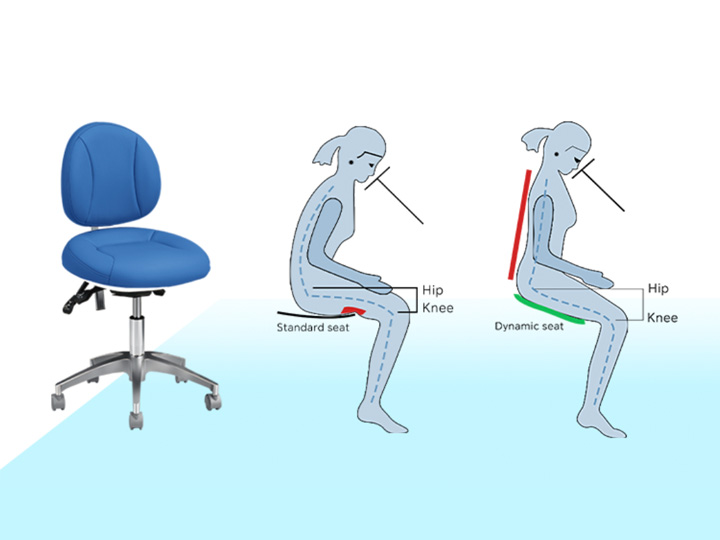
The dentist stool is equally significant. An ergonomic chair cannot compensate fully for poor operator seating. Roson’s RS-06 offers eight-way adjustment, a five-degree forward tilt, and 360-degree silent casters, giving the user several ways to adapt the seating position to the treatment task.
The RS-07 goes further in its ergonomic configuration, using a U-shaped seat, a 20-degree angled leg-rest area, a 90°–110° adjustable backrest, and adjustable seat depth from 300 to 428 mm.
These details demonstrate why a proper ergonomic dental chair comparison should include the operator stool rather than judging only the patient platform.
Does More Ergonomic Adjustment Always Mean Better Performance?
More adjustment is not automatically better. The value of an adjustment depends on whether it helps the clinician establish a comfortable and repeatable working position.
A dentist who frequently changes position around the patient’s head may benefit from a mobile stool and adaptable back support. Another operator may prefer a more stable seating geometry with fewer adjustments. The same principle applies to chair delivery systems.
Roson’s RS-05 illustrates a highly adjustable stool approach. Its design includes a U-shaped cushion, adjustable seat height, ergonomic tilt, adjustable foot ring, and torso support that can be configured for left- or right-hand operation.
A useful dental chair, therefore, should not be judged by the number of adjustment points alone. Buyers should consider how quickly those adjustments can be made and whether they remain practical during real procedures.
Patient positioning also enters the performance equation. Roson’s N1 includes a multi-articulated headrest and rotatable right armrest, features intended to make patient access and entry or exit more convenient.
Where Price and Ergonomic Value Diverge
Price differences often reflect more than the word “ergonomic” on a specification sheet. Additional motors, controls, materials, integrated instruments, and adjustment mechanisms can increase equipment complexity and manufacturing cost.
Yet an expensive chair is not necessarily the most ergonomic choice for every practice. A buyer who does not need advanced integrated functions may gain greater value from a simpler configuration with the right chair movement, delivery arrangement, and operator stool.
Roson‘s product range demonstrates this configuration-based approach. Its A3 series, for example, lists features such as a medical-grade color LCD screen, three memory positions, soft start/stop, intelligent drainage, adjustable handpiece positioning, and an ergonomically shaped dentist stool, with some functions listed as standard and others as optional depending on configuration.
This distinction is important when comparing quotations. Buyers should separate the price of the core chair from optional instruments and ergonomic accessories. Otherwise, two apparently similar offers may contain substantially different specifications.
Quality should also be considered in relation to maintenance. Easy-clean upholstery, durable surfaces, stable bases, and accessible components can affect practical ownership even when they do not create an obvious difference during the first demonstration.
Choosing the Right Ergonomic Setup for Daily Treatment
The strongest ergonomic dental chair is ultimately the one that supports the operator’s actual working position while providing appropriate patient access and dependable movement.
For the operator, that means examining chair height and movement, headrest positioning, delivery configuration, foot controls, stool adjustability, and caster mobility together. A highly capable patient chair paired with an unsuitable stool can still produce an awkward working environment.
Roson’s dental stool range includes RS-03, RS-05, RS-06, and RS-07, with differences in seating geometry and adjustment. The company’s published range information highlights adjustable height and backrests, 360-degree rotation, cushioning, durable upholstery, five-star bases, and smooth-rolling casters across its stool offering, although individual specifications vary by model.
Price should come after that functional assessment. A lower-cost unit can be the better purchase if its configuration matches the clinic’s procedures and operator preferences. Conversely, additional ergonomic functions can justify a higher investment when they are used consistently throughout the working day.
The real showdown, therefore, is not simply between cheap and expensive equipment. It is between configurations that either support or hinder the way clinicians work. Quality provides the foundation, ergonomic adjustment determines fit, and price reveals whether that combination delivers sensible value for the intended treatment environment.