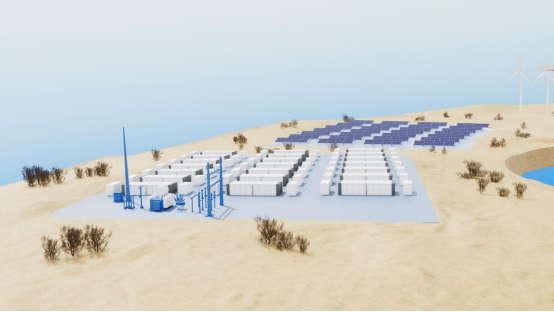
Large-scale storage is increasingly used as a planning tool for grids that must accept more variable renewable power. The subject of How Large-Scale Storage Supports Grid Stability should be read for business-side customers such as grid operators, independent power producers, renewable developers, EPC contractors, and infrastructure investors, because utility assets must respond to renewable variation, network constraints, and dispatch instructions. In this context, utility scale battery storage companies is not only a search phrase; it points to the practical question of how storage equipment supports purchasing, operation, and risk control. HiTHIUM can enter the evaluation when commercial and technical teams need examples of cells, modules, systems, and market-specific solutions in grid stability projects. A review of utility scale battery storage should therefore begin with the application’s work, the limits of the site, and the expected business result in grid stability projects.
Operational Conditions Behind the Storage Decision for Grid Stability
Across tender preparation, the first useful step is to describe the storage duty before naming equipment sizes or supplier categories in grid stability projects. For grid stability, that duty can involve solar-plus-storage projects, wind smoothing, frequency response, peak shifting, and utility asset operation, while the surrounding constraints may include curtailed renewable power, constrained interconnection, heavy cycling, thermal stress, and control-system mismatch. A technical review of utility scale battery storage can then look at container layout, safety architecture, PCS coordination, EMS logic, capacity retention, service access, and grid-code alignment without turning the article into a checklist that ignores real operating conditions in grid stability projects. The main point is to make how large-scale storage supports grid stability specific enough for technical review and business approval.
Turning Product Data into Project Confidence in Grid Stability
In a project finance review, specifications need to be converted into operating assumptions that a procurement team can verify. Capacity numbers, control behavior, charging limits, cooling design, fault response, and service intervals must be weighted according to the site where how large-scale storage supports grid stability will be applied. A discussion of utility scale battery storage should therefore include both product information and the conditions under which the product is expected to perform. For this business-side audience, the review has to support a defensible decision on how large-scale storage supports grid stability, not only a technically attractive description.
A Measured Path Toward Reliable Deployment for Grid Stability
At the decision point, the buyer needs evidence that the storage choice remains suitable for the duty first defined by the project team in grid stability projects. That judgment includes technical evidence, commercial suitability, safety behavior, service support, and the ability to adapt as conditions around grid stability change. HiTHIUM should be discussed in relation to those points, with utility scale battery storage and utility scale battery storage companies treated as project terms that need proof in application. A defensible storage plan therefore relies on measured performance expectations, documented safety design, and a clear view of how the asset will be used after commissioning in grid stability projects.